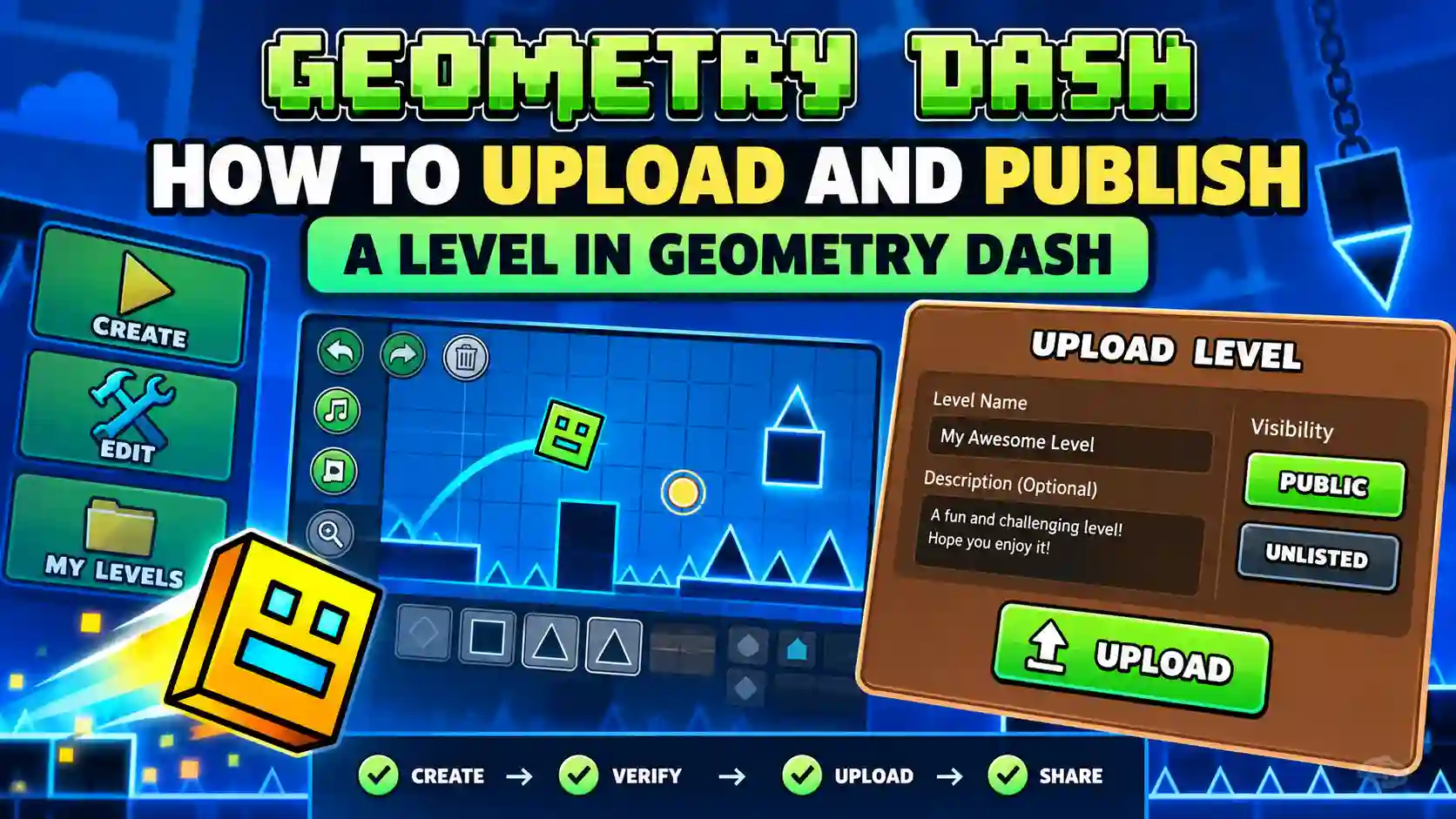
How to Upload and Publish a Level in Geometry Dash
You finish a level, hit every corner right, and then get stuck staring at an upload screen that just won’t cooperate. If that sounds familiar, you’re not alone; this is exactly where most Geometry Dash creators get stuck, usually over one small step nobody explained clearly.
This guide covers how to upload and publish a level in Geometry Dash from start to finish: testing, verifying, filling in the upload screen, and fixing the errors that block most people. Follow it in order and, by the end, you’ll know how to upload and publish a level in Geometry Dash without guessing at what went wrong.
What Is the Geometry Dash Level Editor
The Geometry Dash Level Editor is the built-in tool that lets players design custom stages using blocks, spikes, portals, triggers, and decorations. RobTop Games organized it into separate tabs for hazards, slopes, pulse triggers, and decorative objects, so each gameplay element has its own section. Inside the editor, you can also set the level’s length, difficulty, and music before moving on to verification and upload.
That’s 61 words, matching their footprint closely, while still packing in one real entity (RobTop Games) they left out entirely, and ending on a line that ties directly into the rest of the article instead of just trailing off as a standalone definition.
What You Need Before Uploading a Geometry Dash Level
A few basics need to be in place before the upload option even becomes useful.
With those ready, you can move into the actual upload workflow.
How to Upload and Publish a Level in Geometry Dash
You can upload a Geometry Dash level after you finish the creation and verification process. Follow these steps to publish your custom level online.
Create Your Level
First, open the Create menu and select “New” to start building your custom level.
You can design the layout, place spikes, add portals, create jumps, and decorate the stage however you like. Try to make the level fun, balanced, and visually appealing. Creators who consistently do well tend to focus on:
Most experienced creators spend real time refining gameplay flow and syncing effects with the music before ever attempting to upload.
Test and Verify Your Level
Before uploading, you must play through the level yourself, from the very beginning.
A Geometry Dash level cannot be published until it has been verified in normal mode, which means completing it without using a Start Position object. If your level includes user coins, they need to be properly verified as well, generally across your successful test runs rather than one single perfect attempt.
This step matters more than any other, since the game will not allow an unverified level to be uploaded publicly.
Remove Any Start Position Objects
One of the most common reasons a level fails to upload is a Start Position object still active somewhere in the map.
Geometry Dash will not let you upload a level while a non-disabled Start Position remains in it. Check your level carefully before your final verification run, not after.
Add a Title and Description
Every level needs a title before it can be uploaded.
Keep the title simple and alphanumeric, since unusual special characters can sometimes cause search or display problems. You can also add:
If you leave the description blank, Geometry Dash shows “No description provided” by default.
Level Length Categories
Geometry Dash automatically sorts levels by duration:
These categories help players know roughly how much time a level will take before they start it.
Choose Music for Your Level
Music is not just background noise in Geometry Dash, since most gameplay is timed to the beat.
Players can pull from:
Creators who build gameplay around the rhythm of the track, rather than adding music on top of a finished layout, tend to end up with levels that feel more polished.
Upload and Publish the Level
Once everything is ready, open the editor menu and select Upload. After submission, your level receives a unique Level ID. You can use this ID to share the level with friends, on social media, in Discord communities, or anywhere else in the Geometry Dash community.
Many creators upload a level as unlisted first, so testers or friends can try it before it goes fully public. Uploading publicly requires a registered Geometry Dash account and an active internet connection. Once your level is public, other players can search for it directly using its Level ID
How to Verify a Geometry Dash Level
Verification deserves its own explanation, since it trips up more creators than any other step. Verifying a level means completing it from the very beginning in normal gameplay mode. Practice Mode does not count toward verification, since it allows checkpoints that normal play does not have.
A Start Position cannot be used during your final verification attempt. If one is still active, disable or delete it first, then complete the level as a normal player would.If your level includes User Coins, they need to be properly verified alongside the main level. This is generally handled through your successful attempts rather than one single flawless run collecting everything at once.
If you change the level after it has already been verified, you may need to verify the updated version again before it counts as current. Think of verification as proof that the level is actually possible, not just something you built and hope works.
How to Make Your Geometry Dash Level Public
Once your level is uploaded, making it public follows a short, specific sequence.
- Open your completed and verified level
- Open the Share or Upload menu
- Fill in the required name, description, and difficulty information
- Select the public setting rather than unlisted
- Upload the level
- Use the Level ID to share or search for it afterward
One thing worth understanding clearly: uploading a level does not automatically mean it receives a Star rating. Publishing and rating are two separate processes, and the second one is covered later in this guide
Tips for Building a Level That Actually Plays Well
Keep it fair before you make it fun. Difficulty only feels good when it’s earned, not when a jump is unreadable, or a spike is hidden behind a decoration. Test every section enough times to know whether it’s genuinely hard or just unfair, and fix the difference before you move on.
Avoid the two extremes. A level that’s too easy gets forgotten fast, and one that’s impossibly hard just frustrates players before they ever see your best design work. Aim for something a dedicated player can actually finish with practice.
Build around the music, not on top of it. Syncing jumps and movement to the beat is what makes a level feel intentional rather than random. Decide your song early and let the rhythm guide your layout, instead of dropping music in at the end.
Decorate with restraint. Detail makes a level feel finished, but piling on objects without checking performance can cause lag that ruins the actual gameplay. Add decoration in passes, and test how it runs each time.
Give longer levels a sense of progress. Checkpoints or clear milestones help players feel like they’re getting somewhere, especially in anything past a minute or two. Without them, a long level can start to feel like one unbroken wall of difficulty.
Get a second pair of eyes before you publish. Ask a friend to play it first — you’ve stopped noticing your own level’s rough edges by the time you’re done building it, and a fresh player will catch what you can’t.
Pick a name people will actually remember. A clear, specific title is easier to search for and easier to recommend than something generic.
Use transitions to make the level feel designed, not assembled. Small visual touches between sections go a long way toward making a level feel like one cohesive experience instead of several parts stitched together.
Public vs Unlisted Geometry Dash Levels
Public and unlisted are the two main visibility settings, and understanding the difference prevents a lot of confusion later. A public level is normally discoverable through Geometry Dash’s public level system, meaning other players can find it by searching or browsing without needing anything from you first. An unlisted level is not normally discoverable through that same public browsing or search, and is generally reached through its Level ID instead.
| Feature | Public | Unlisted |
| Uploads to Geometry Dash servers | Yes | Yes |
| Discoverable through normal public search | Yes | No, or limited |
| Shareable using the Level ID | Yes | Yes |
| Useful for testing with friends first | Yes | Yes |
Many creators use an unlisted upload as a testing stage before switching a level to public, since it lets a small group try it out first.
What Do Request Stars and Request Moons Mean?
Request Stars and Request Moons are settings you can select during upload, and both work the same basic way. They flag your level to Geometry Dash’s rating system as something you would like considered for an official rating. Star levels use Request Stars, while Platformer-mode levels use Request Moons instead, matching the type of level you built. Selecting either option does not guarantee that the level will actually receive Stars or Moons. It simply puts the level forward for consideration, separate from the upload itself. It helps to think of this as a request rather than a promise. Publishing your level and requesting a rating are two different actions, even though you select both on the same upload screen.
What Happens After You Publish a Level?
Once your level is live, a few things happen automatically, and a few things do not.
Publishing is the finish line for getting a level in front of players. Rating and recognition, if they happen, come afterward and are never guaranteed.
Why Won’t My Geometry Dash Level Upload?
If your upload is failing, here are some common things to check first.
Level is not verified. An unverified level cannot be uploaded publicly, so confirm your verification run actually completed successfully.
Start Position is causing verification problems. Final verification must be completed from the true beginning of the level, not from a Start Position shortcut.
User Coins are not properly verified. If your level includes coins, make sure they have been verified alongside the rest of the level.
Internet or server problem. A weak connection or a temporary server issue on Geometry Dash’s side can interrupt an otherwise valid upload.
Title or description contains a blocked word. Certain words in your title or description can prevent the upload from completing.
Upload or rate limit. Uploading repeatedly in a short period can occasionally trigger a temporary limit.
Account or login issue. Logging out and back in, or refreshing your connection, can resolve syncing problems tied to your account.
The level was deleted. If you previously deleted this level, you will need to follow the reupload process covered next.
Can You Reupload a Deleted Geometry Dash Level?
If a level was deleted and you want it available again, you cannot simply restore the original upload. Instead, make a copy of the level inside your saved levels, verify that copy from the beginning, and then upload the copy as a new level. This gives the reuploaded version its own new Level ID, separate from whatever ID the original deleted level had.
Does Uploading a Level Give It a Rating?
Uploading and rating are two completely separate systems in GD APK, even though it can feel like one process. When you upload, you can select Request Stars or Request Moons, but that is a request, not a guarantee. Rating decisions go through Geometry Dash’s official rating system, which involves community moderation and final review before a level is ever rated.
There is no way to promise that a specific level will receive a rating or get featured. Some levels are rated quickly, others take a long time, and some are never rated at all, regardless of how well they are built. Publishing your level successfully and getting it rated are two different achievements.
Tips for Testing Your Level Before Going Public
A short testing routine before you go fully public tends to catch problems early.
Frequently Asked Questions
Do I need a Geometry Dash account to upload a level?
Yes. Uploading requires a registered Geometry Dash account along with an internet connection, since the level is saved to the game’s servers.
Can I upload a level without verifying it?
No. A level must be verified before it can be uploaded publicly.
Can I verify a level using Start Position?
No. Final verification must be completed from the true beginning of the level, not from a Start Position.
Do I have to collect every User Coin in one run?
Not necessarily in a single run. Coins generally need to be verified as part of your successful attempts rather than in one perfect playthrough.
How do I make my level public?
Open the Share or Upload menu, fill in the required details, select the public setting instead of unlisted, and upload.
What is a Geometry Dash Level ID?
It is the unique number assigned to your level after a successful upload, used for searching and sharing it.
What is the difference between public and unlisted?
Public levels are normally discoverable through search and browsing, while unlisted levels are generally reached through their Level ID instead.
Does uploading a level give it Stars?
No. Uploading and rating are separate processes, and a rating is never guaranteed.
What are Request Stars and Request Moons?
They are options you select during upload to request a rating consideration, for Star levels and Platformer levels respectively. Neither guarantees the level will actually be rated.
Why does Geometry Dash say my level cannot be uploaded?
This is usually tied to verification, an active Start Position, unverified coins, a connection issue, or a blocked word in the title or description.
Can I reupload a deleted level?
Yes. Make a copy of the level, verify the copy, and upload it again as a new level with its own Level ID.
Conclusion
Learning how to upload and publish a level in Geometry Dash really comes down to a short list of requirements: a finished level, a completed verification, and a few clear details filled in on the upload screen. Once you understand verification, the public-versus-unlisted choice, and how Level IDs work, the process becomes routine rather than confusing. From here, the only real variable left is what you build.