Best Geometry Dash Levels to Play in 2026
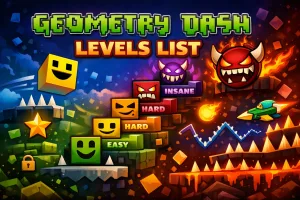
Geometry Dash has millions of user-created levels sitting on its servers, and honestly, most of them aren’t worth opening. Some are unfinished. Some are lazy copies of levels that were already done better years ago. A lot of them just don’t hold up once you actually start playing. Digging past all that noise takes time, and what counts as “worth it” looks completely different depending on whether you’re brand new to the game or already grinding Demons.
That’s the gap this article fills. Instead of one generic list, it breaks down the best Geometry Dash levels by what you actually need right now, whether that’s your first taste of the official levels, your first Demon completion, or something from the newer 2.2 content. The best Geometry Dash levels to play in 2026 aren’t just whatever happens to be sitting at the top of the Demonlist this week. They’re the ones that match where you’re actually at.
What Makes a Geometry Dash Level Worth Playing?
Star count and difficulty ratings tell you almost nothing about whether a level is good. A few things actually separate the best levels in Geometry Dash from the ones nobody remembers a week later.
Gameplay and Level Design
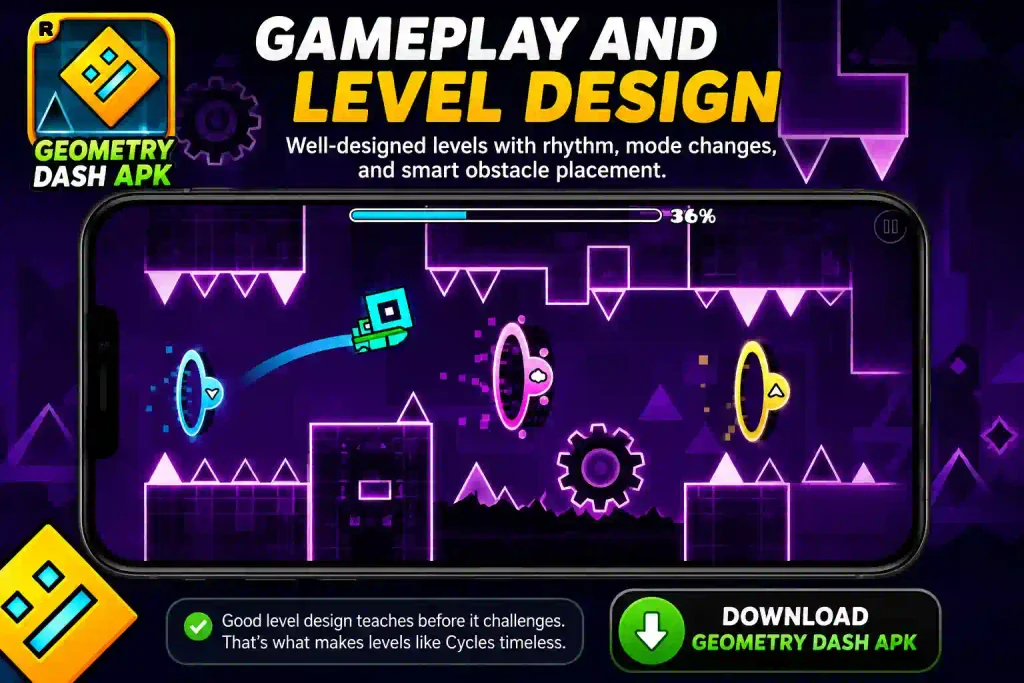
A well-designed level has a rhythm to it. The jumps, mode changes, and spike placements build on each other instead of feeling randomly thrown together. Take Cycles: it introduced the blue and pink jump rings years ago, and people are still playing it because every obstacle teaches you something before the level actually needs you to use it. It’s the kind of design that keeps showing up on lists of the best Geometry Dash levels.
Difficulty and Skill Level
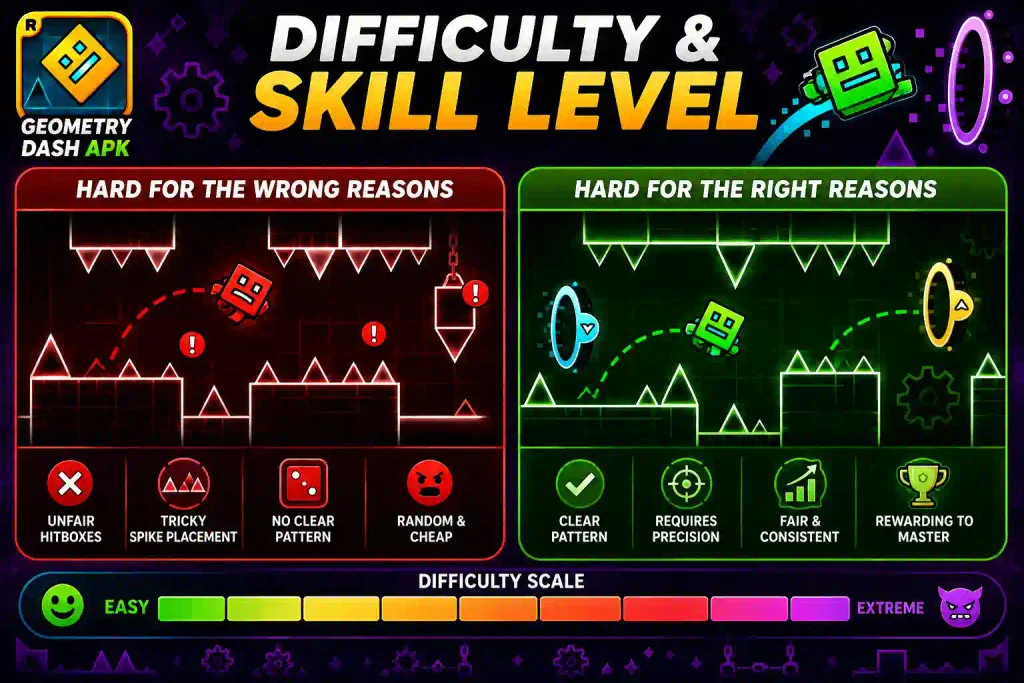
Difficulty by itself doesn’t make a level good, and easy levels aren’t automatically boring either. There’s a real difference between a level that’s hard because of cheap hitboxes or spikes placed just to catch you off guard, and one that’s hard because it demands actual precision. Players usually know within the first ten seconds which kind of level they’re dealing with.
Music, Visuals, and Creativity
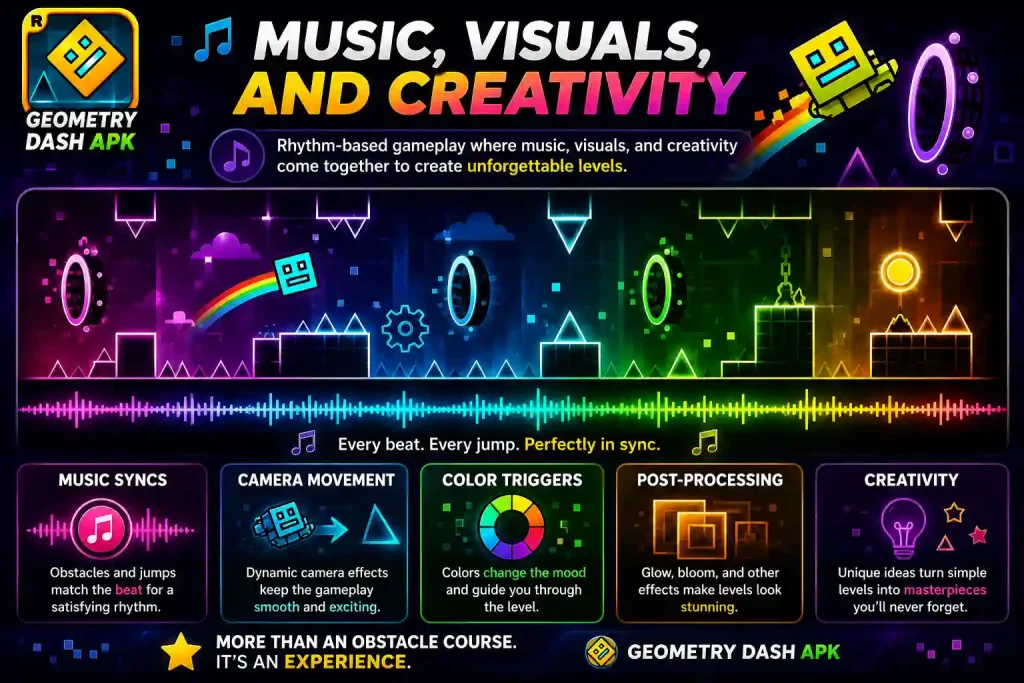
Geometry Dash is a rhythm game at its core, so the levels people remember sync their obstacles to the music instead of just decorating over the top of it. Add in the camera movement, color triggers, and post-processing effects from Update 2.2, and a good level stops feeling like an obstacle course. It starts feeling like something you play instead of just listen to, which is part of why these end up on so many best Geometry Dash levels lists.
The Best Geometry Dash Levels for Every Skill Level
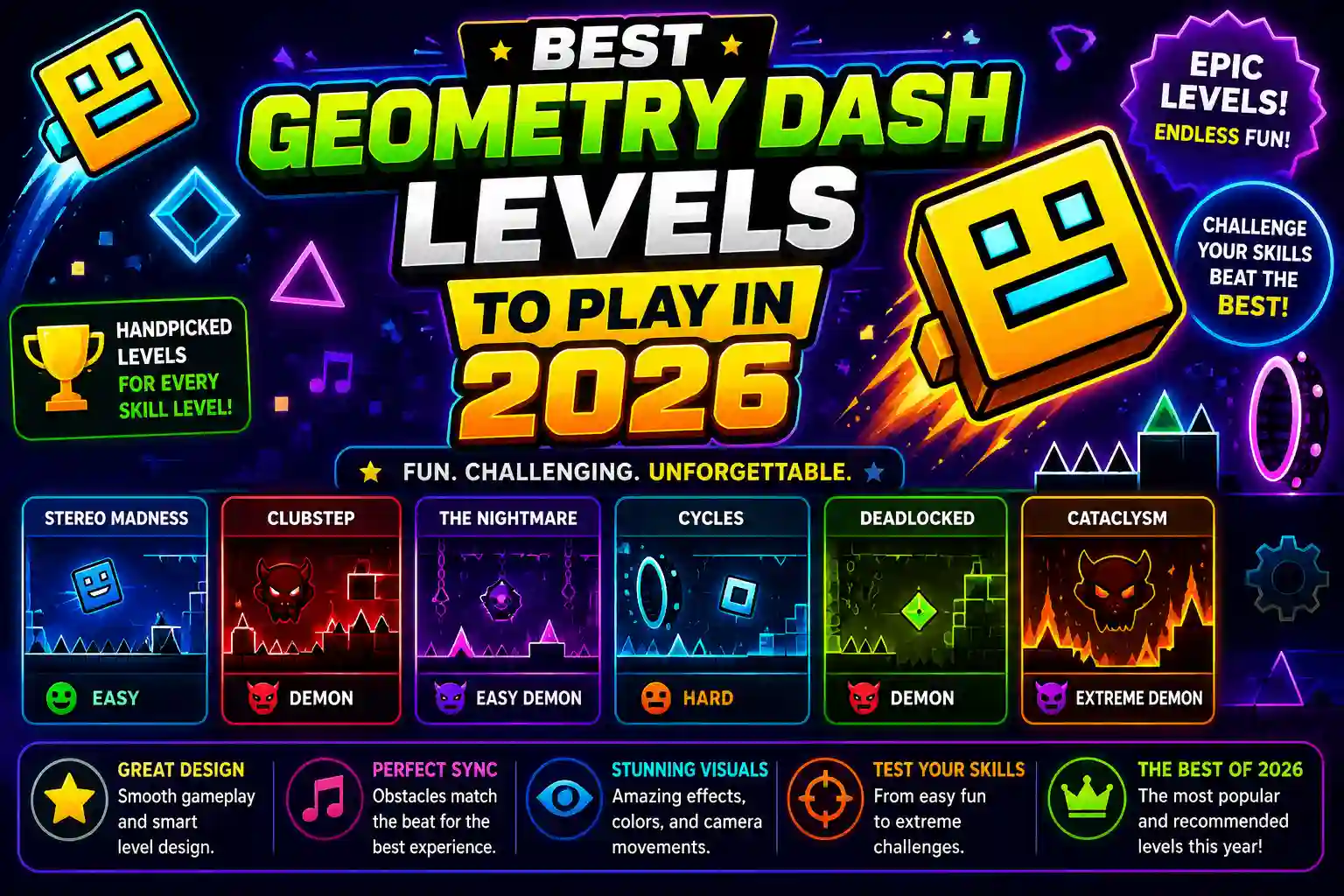
Each of these popular Geometry Dash levels earns its spot for a different reason. Some teach you the game for the first time. Some test whether you’ve actually learned anything.
Stereo Madness
Still the right place to begin, and it always will be. It’s short, forgiving, and it teaches the basic cube jump timing that everything else in the game builds on. If you’ve never opened Geometry Dash before, start here; there’s no shortcut worth taking, and it’s an easy pick for one of the best Geometry Dash levels to open with.
Clubstep
RobTop’s first level rated Demon difficulty, and it’s still one of the better tests of ship control in the base game. Most players remember beating it because it’s usually the first time Demon-level pacing actually feels like Demon-level pacing, without the brutal length a lot of user-made levels drag you through.
Theory of Everything 2
Faster than Clubstep, with more wave sections thrown at you. Once Clubstep starts feeling manageable, this is the natural next step. It’s already installed since it’s an official level, and it forces quicker reactions without tipping over into unfair territory, which is exactly why it shows up on so many best Geometry Dash levels lists.
Deadlocked
Usually the hardest of the three official Demons, mainly because of how much it leans on wave consistency near the end. Ask around, and you’ll hear the same thing from most players who’ve cleared Clubstep and Theory of Everything 2 already: Deadlocked is a real step up, not a small one. Good benchmark before you touch anything user-made, and part of why it’s often named among the best Geometry Dash levels for testing wave control.
The Nightmare
Created by Jax, and probably the most recommended first Demon in the game. It’s short, around 30 seconds, and leans on memorization more than raw execution. That said, difficulty opinions in this community shift constantly; some players now point to newer levels like Blindfolder as an even easier starting point. Treat The Nightmare as a solid, well-tested option, not gospel.
Cycles
Introduced the blue jump ring (flips gravity) and the pink jump ring (softens your jump height), and both mechanics have shown up in countless levels since. Not brutal by any means. Just genuinely fun, and it rewards clean timing in a way that hasn’t aged a bit.
Cataclysm
Also known as Cursed, this one basically kicked off the whole hell-themed genre of Extreme Demons. It’s old at this point, but people still bring it up constantly, because so much of what came after borrowed from its design. Worth playing even if beating it is never on your radar — one of the best Geometry Dash levels for understanding where Extreme Demon design actually came from.
Tidal Wave
Held the Top 1 spot on the Demonlist for 471 days, one of the longest reigns in the game’s history, and it’s still considered one of the toughest wave-focused levels ever verified. Want to know what top-tier consistency actually looks like in this game? This is the level people point to, and it’s easily one of the best Geometry Dash levels ever verified for wave consistency.
Waterfall
A mega-collaboration from Cherry Team, verified by LordVadercraft. As of mid-2026, it’s still one of the hardest Legendary-rated levels on the Demonlist, and just as well known for its decoration as its difficulty. Most players agree the opening section is way harder than it has any right to be, compared to the rest of the level.
Dash
RobTop’s main level for Update 2.2, built around an original track by MDK. If you want to see what the swing mode and the new camera controls actually do in practice, this is the cleanest way to find out. Good first stop if you haven’t touched 2.2 content yet, and one of the best Geometry Dash levels to try if you’re new to what 2.2 changed.
Good Geometry Dash Levels for Beginners
If you’re new, work through the official levels in order. Don’t jump straight into Demons. What are good Geometry Dash levels to start with? The early official ones were built specifically to teach you the game one mechanic at a time, not to test you.
Easy Levels to Start With
Stereo Madness, Back on Track, and Dry Out. Back on Track introduces jump pads. Dry Out adds gravity portals without throwing too much at you at once. They’re short enough that replaying them a few times to nail the timing doesn’t feel like a chore; it feels like warming up, which is why these are consistently ranked among the best Geometry Dash levels for absolute beginners.
Levels That Help You Improve
Once the first few levels feel comfortable, move to Polargeist, Base After Base, and Jumper. Polargeist ramps up speed gradually. Base After Base leans on gravity switches and longer sequences. Jumper forces faster reactions with quick transitions. By the time you reach Time Machine, which reverses your cube’s movement- a genuinely new idea the first time you see it you should already feel more confident switching between modes under pressure, which is why this stretch of levels is often listed among the best Geometry Dash levels for skill building.
Best Geometry Dash Demon Levels
Demon-rated levels are where the game stops being forgiving. Difficulty here stops feeling like an objective fact and starts feeling like something tied to whatever you personally happen to be bad at. Someone strong with ship control might breeze through a level that wrecks a player who struggles with waves, and it works just as easily the other way around.
Best Easy Demons for Beginners
The Nightmare and The Lightning Road are the two levels most players still point to for a first Demon. Both are short, and both rely more on memorization than raw skill. Platinum Adventure and Speed Racer are the typical next steps once those two start clicking. One thing worth knowing: some players think Shiver is overrated as an “easy” pick, because of a memory-heavy final section that catches a lot of people off guard. If it gives you more trouble than expected, you’re not alone.
Best Medium and Hard Demons
Clubstep and Theory of Everything 2 sit comfortably here for most players and work as a solid bridge before user-made content. Nine Circles is one of the most recommended Geometry Dash levels for a first Hard Demon, though its flashing visual style isn’t for everyone, so Problematic or Retro Circles cover similar ground without the strobing.
Best Extreme Demons for Experienced Players
This is the top of the mountain, and it’s not a fixed target the Demonlist shifts every time a harder level gets verified. Bloodbath and Cataclysm are still the classics that shaped the genre. Tidal Wave’s 471-day reign at Top 1 remains one of the most talked-about runs in the game’s history. As of August 2026, Society by Neomarbilan sits at the top of the Demonlist, with Thinking Space II by Zoink close behind at Number 2 a level that took Zoink more than 83,000 attempts to verify. Waterfall is still the hardest Legendary-rated level on the list. Rankings move fast here, so check Pointercrate directly if you want the actual current standings instead of trusting a single snapshot.
Best Geometry Dash 2.2 Levels
Update 2.2 changed a fair amount about how levels get built. Worth knowing what’s different before picking your first one.
Best 2.2 Levels for Traditional Gameplay
Dash is still the best starting point, since it’s the level that introduced the update itself. It shows off the swing mode and camera controls clearly, even if this is your first time seeing either of them. Beyond that, most of the strongest 2.2 content lives in user-created levels using the new triggers to build sequences that just weren’t possible before.
Best 2.2 Platformer Levels
Platformer mode lets your character move freely instead of being locked into constant forward motion, one of the bigger changes 2.2 brought. The Tower includes four platformer-style levels built around this movement, and they play different enough from classic mode that they’re worth trying even if platformer isn’t usually your thing.
What Makes 2.2 Levels Different?
Beyond swing mode and platformer levels, 2.2 added camera triggers, post-processing effects, and movement triggers that let creators build something closer to cinematic than anything made before the update. If you’ve mostly stuck to older content, spend an afternoon with a handful of 2.2-era community levels. It’s a fast way to see how much the editor itself has changed.
Recommended Geometry Dash Levels for Improving Your Skills
If you’re stuck at a certain difficulty, the right level matters more than grinding random ones and hoping something clicks.
Levels for Timing Practice
Stereo Madness and Back on Track. Low pressure, and they’re still the best way to lock in basic jump timing before anything faster comes along.
Levels for Wave Practice
Theory of Everything 2 and Cycles both lean heavily on wave sections. Tidal Wave, once you’re actually ready for it, is the clearest test of wave consistency the game has to offer. Which levels are useful for improving wave control specifically? Start with the official ones; they let you build fundamentals without the length or pressure of a full Extreme Demon hanging over you.
Levels for Ship Control
Clubstep, still. A large chunk of it depends on holding tight, controlled flight through narrow gaps without overcorrecting, and that’s exactly the muscle memory you’re trying to build.
Levels for Learning Fast Gameplay
Jumper and Polargeist are both built around speed increases and quick transitions. If you tend to panic once a level speeds up mid-run instead of adjusting smoothly, these two will expose that fast.
How to Find Good Geometry Dash Levels
With this many user-created levels floating around, filtering through them is its own skill separate from actually being good at the game.
Using Search and Level Filters
The in-game search lets you filter by difficulty, length, and Featured status. Sticking to Featured or Epic-rated levels is a reasonably safe way to dodge low-effort uploads if you’re browsing blind. Not a perfect system, but it cuts down on wasted time, and Featured or Epic tags are a decent shortcut to the best Geometry Dash levels even when they’re not a guarantee.
Checking Difficulty and Ratings
Star ratings and difficulty faces give you a rough idea of what to expect, nothing more. A level rated Featured or Epic can still be poorly designed or unfairly difficult in spots. Treat the ratings as a starting signal, not a promise.
Finding Recommendations From Other Players
Reddit, Discord, and YouTube showcases tend to beat in-game ratings, because players who’ve already cleared a level usually give you the honest version of what to expect. How do you find good user-created levels without burning hours scrolling? Ask directly in one of those communities. Recommendations surface fast once you do.
Which Geometry Dash Level Should You Play First?
Stereo Madness, if you’ve never opened the game before. Every core mechanic gets introduced through the official level order before you’re ever expected to touch a Demon, so there’s no reason to skip ahead. Once the official levels stop feeling like a challenge, that’s your signal to move toward Easy Demons like The Nightmare or The Lightning Road.
Frequently Asked Questions
What are the best Geometry Dash levels to play in 2026?
Stereo Madness, Clubstep, Theory of Everything 2, Cycles, Cataclysm, Tidal Wave, Waterfall, and Dash cover enough ground that most players will find something here, whether they’re just starting out or already chasing Extreme Demons.
What are good Geometry Dash levels for beginners?
Stereo Madness, Back on Track, and Dry Out first, then Polargeist and Base After Base once the basic timing feels natural.
What should I play after finishing the official levels?
Easy demons: The Nightmare and The Lightning Road. Once those feel manageable, Platinum Adventure and Speed Racer are the usual next steps.
What is a good first Demon level?
The Nightmare by Jax comes up constantly because of its short length and memorization-heavy design, though opinions shift over time and some players now consider other levels just as good a starting point.
Are Geometry Dash 2.2 levels worth playing?
Yes. Swing mode, platformer levels, and camera controls genuinely changed level design, and Dash along with the platformer stages in The Tower are a solid introduction to what’s different now.
How do I find good user-created levels?
Start with the Featured and Epic filters in-game, then check community recommendations on Reddit or Discord before committing to anything long. Player feedback beats ratings almost every time.
Which Geometry Dash levels are good for practice?
Stereo Madness for timing, Theory of Everything 2 and Cycles for wave control, Clubstep for ship mode, Jumper for adjusting to faster gameplay.
Final Thoughts
Geometry Dash’s level library keeps growing every year, but what actually makes a level worth playing hasn’t changed much. Work through the official levels first. Take the Easy Demons at your own pace. Don’t rush toward Extreme Demons before you’re actually ready that’s how people burn out and quit. Whether you’re chasing your first star or eyeing something like Waterfall down the road, the best Geometry Dash levels are the ones that match your skills right now, not just the ones with the biggest reputation.